UBS Divest From Elbit
No Profits from War Crimes
A Decades-Long Crime: From Apartheid to Genocide
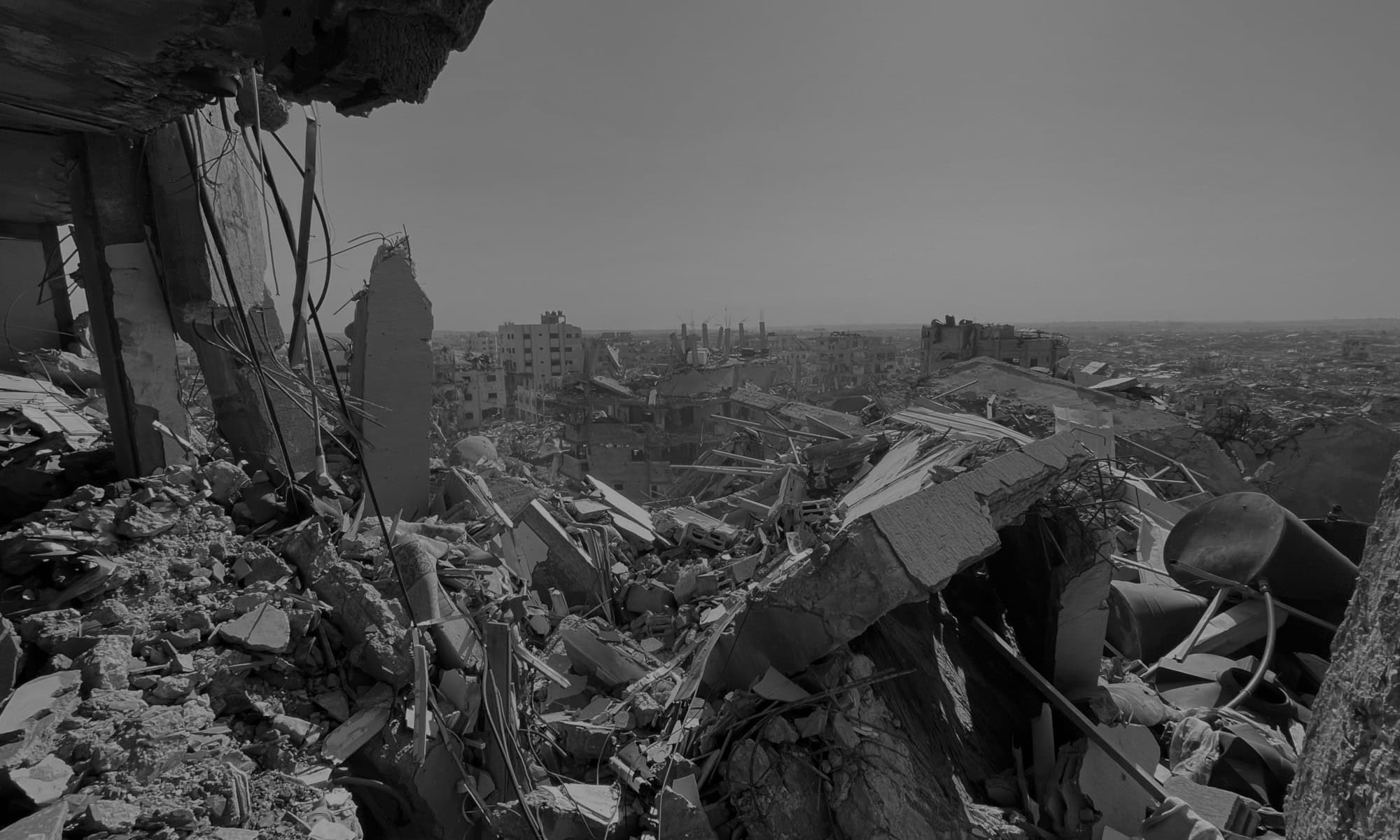
Since October 2023, the Israeli army has targeted aid and healthcare workers, including nurses and doctors, as well as journalists in Gaza. It has destroyed hospitals, universities, mosques and churches, and 90% of the housing and public utility services. These patterns of violence and systematic destruction suggest deliberate intent, thus reinforcing the accusation of genocide.
As of June 2025, the official death toll in Gaza had passed 62000. Yet The Lancet, a leading medical journal, had already estimated the figure to lie between 55,298 and 78,525 a year earlier, highlighting the significant discrepancy between the verified figure and the actual number of victims. This estimate did not even account for “at least 12,000 people still missing under the rubble and presumed dead”, nor for non-traumatic deaths due to the military operation, “which could push all-cause excess mortality to 186 000”. The UN Human Right Office reported that 70% of those killed were women and children. Israel is now furthermore using famine as a weapon of war.
On January 26, 2024, the International Court of Justice (ICJ) stated in a landmark ruling that there was a plausible risk of genocide in Gaza. On April 29, 2025, Amnesty International concluded in its annual report: “Amnesty International’s research found that Israel committed acts prohibited under the Genocide Convention with the specific intent to destroy Palestinians in Gaza, thus committing genocide. These acts included killings, causing serious bodily or mental harm to civilians and deliberately inflicting conditions of life calculated to bring about their physical destruction.“
This accusation is increasingly recognized by international organizations and must be understood in its broader context: these events are unfolding within a long-standing system of apartheid. On July 19, 2024, the ICJ found Israel’s military occupation and annexation of Palestinian Territory illegal. Important NGOs such as Amnesty International, Human Rights Watch, Doctors Without Borders and B’Tselem had already documented the crime of apartheid years before.
In the occupied West Bank, Palestinians have faced an intensified wave of violent oppression since 2023. Attacks by Israeli forces and settlers have surged, accelerating displacement. In 2024 Israel demolished a record number of Palestinian structures and reclassified 2,470 hectares as “state land”, surpassing all land seized over the past 20 years.
Elbit: Weapons Supplier of Genocide and War Profiteer
Israel is the eighth largest arms exporter in the world. The arms and security industry is a critical pillar of its economy. Elbit Systems Limited (hereafter Elbit) supplies 85% of drones and small-caliber ammunition to the Israeli army, the Israel Defense Forces (IDF). After acquiring Israeli Military Industries in 2018, its product range expanded significantly.
Elbit’s Skylark and Hermes drones, key component of Israel’s fleet, have been extensively used in in Gaza. In April 2024, seven aid workers were reportedly killed by an IDF Hermes 450 drone, among many other unlawful attacks. Elbit has contributed to constructing and maintaining Israel’s illegal Apartheid Wall in the occupied West Bank, equipping it with surveillance and automated weaponry. Its MPR 500 multi-purpose bombs, designed for “densely populated urban warfare” undermine the distinction between civilians and armed combatants, fundamental for the fourth Geneva Convention.
Elbit profits from war. Its sales spike after every attack on Gaza, since its weapons are promoted as “battle-tested”, meaning “tested on Palestinians populations”, mostly civilians. This sales pitch makes investing in Elbit very profitable and the Israeli arms companies readily acknowledge the impact of the war on their business. Since the beginning of the onslaught on Gaza in 2023, Elbit has experienced a significant increase in demand for its products and solutions from the Israeli Ministry of Defense. The company’s revenues have risen steadily since the first quarter of 2024, and as of June 2025, its order book has amounted to $23.8 billion.
UBS: One of Elbit’s Largest Institutional Investors and Economic Accomplice
Arms manufacturers and investors share mutual interest in armed conflicts. The sale of weapons increases during and after conflicts. The arms companies also rely on foreign capital to scale up production. UBS, the world’s largest private bank, has taken full advantage of the genocide in Gaza by increasing its investment in Elbit by 875% in the first quarter of 2024. Over the following five quarters, from March 2024, to June 2025, UBS further strengthened its position, multiplying its holdings by more than tenfold. As of June 2025, these shares were valued at around $75 million.
UBS claims to be one of the first signatories of the UN Global Compact’s ethical charter in which enterprises promise to make sure that they are not involved in human rights abuses. However, its continued investments in Elbit during the ongoing genocide directly violates the charter’s first two principles. With UBS reporting over $5 billion in net profit for 2024, it seems clear that shareholder returns are prioritized over ethical responsibility.
As the largest private bank in the world and a financial actor of systemic importance following its acquisition of Credit Suisse, UBS is not merely a private enterprise, it is a central pillar of Switzerland’s economic infrastructure. Its scale and influence place it in a category of actors whose decisions have transnational implications. In line with the UN Guiding Principles on Business and Human Rights and the OECD Guidelines for Multinational Enterprises, UBS is obligated to prevent and address adverse human rights impacts it is linked to through its business relationships. These obligations are heightened in contexts where international war crimes are being committed. UBS’s systemic significance does not lessen its responsibility; it amplifies it.
International Law Undermined: UBS’s Legal and Moral Failures
Israel and its allies argue that the ICJ’s ruling is not legally binding. This is not accurate: while it is an advisory opinion, it reflects already binding international obligations. The July 19, 2024 legal opinion clearly asserted that third States and their institutions are obliged to contribute to putting an end to Israeli violations of international law and to sever all diplomatic, economic, commercial, financial and investment relations likely to maintain an illegal presence in the Occupied Palestinian Territory.
Dr Irene Pietropaoli, a recognized expert on business and human rights, declares:
“The ICJ clarified in the Bosnia v. Serbia case that a State is responsible for complicity if its organs were aware that genocide was about to be committed or was under way. (…) The obligation to refrain from being complicit through aid or assistance begins the moment the State becomes aware of the existence of a serious risk that genocide may be committed.”
Private companies also have obligations in this regard. They must exercise due diligence to ensure that their operations and business transactions comply with international law.
Dr Irene Pietropaoli continues:
“Corporations and their managers, directors and other leaders could also be held directly liable for the commission of acts of genocide, as well as war crimes and crimes against humanity. Article VI of the Genocide Convention specifies that ‘persons’ may be held liable for genocidal acts – which include individual businessmen or corporate managers as natural persons and may include corporations as legal persons. The prohibition to commit genocide is a jus cogens norm from which no party, including corporations, can derogate.”
International humanitarian law binds State and non-State actors, including businesses. The Order issued by the ICJ on 26 January finding ‘a real and imminent risk that irreparable prejudice will be caused to the rights found by the Court to be plausible’ means that States and their institutions are now aware of the risk of genocide being committed in Gaza”. UBS’s 2024 investments in the main arms supplier to the Israeli army constitutes a failure in this respect. By aiding and abetting the genocide in Gaza, UBS could be held criminally liable.
Switzerland’s Complicity: Neutrality as a Cover for Inaction
UBS’s investments reflect a broader failure by the Swiss government. During apartheid in South Africa, Switzerland officially condemned the regime, but refused to apply the United Nations’ international economic sanctions, arguing that it would contradict its policy of neutrality. In the meantime, during the embargo, Switzerland allowed South Africa to commercialize its gold in Swiss banks. UBS’s investments in Elbit during the ongoing genocide in Gaza reflects the Swiss government’s unprincipled position
Today, Switzerland claims neutrality while aligning with Israel, which violates its obligations as a signatory and depository of the fourth Geneva Convention. The Swiss state furthermore failed to convene a conference of the high contracting parties on the protection of civilians in the occupied Palestinian territory, as requested in September 2024 by UN General Assembly. According to Amnesty International’s Secretary General, Agnes Callamard, this conference, due by March 2025, was cancelled because “the draft final declaration submitted by Switzerland to the participating states, resulting from a non-transparent process, did not comply with the requirements of respect for international humanitarian law. The July 2024 advisory opinion of the International Court of Justice declaring Israel’s occupation of the Gaza Strip and the West Bank, including East Jerusalem, to be illegal, was also shamefully ignored”.
International law is only as strong as the willingness of states to uphold it. While its rulings are legally binding, enforcement depends entirely on the cooperation of United Nations Member States. When powerful states apply international law selectively, adhering to it when convenient and disregarding it when inconvenient, they weaken the very foundation of the global legal order. The stark contrast between European reactions to Russia’s illegal invasion of Ukraine and Israel’s onslaught on Gaza clearly illustrates the double standards of Global North countries. These states frequently invoke international law to condemn adversaries but fall silent or complicit when strategic allies violate the same principles. Such inconsistency undermines the legitimacy of international law and endangers vulnerable populations worldwide. International law is far from perfect, but weakening it can only lead to the law of the strongest. Swiss government and its institutions and corporations are deliberately undermining international law and international humanitarian law, which is not only legally but also morally unjustifiable.
Time to Act: Civil Society Must End Financial Complicity
Since the Swiss government refuses to act according to its legal and moral obligations, action from the civil society is necessary in order to put an end to such investments. Ultimately, it’s up to us to decide whether we submit to this system of complacency or refuse the complicity of our government, our institutions and enterprises.
We therefore call:
- On UBS to divest from Elbit and any other arms manufacturers complicit in violations of international law and international humanitarian law
- On UBS to respect international law in general, and the ICJ’s advisory opinion of 19 July 2024 in particular. It must take the necessary steps to ensure that its investments do not render aid or assistance in maintaining the situation created by the continued presence of the State of Israel in the Occupied Palestinian Territory
- On civil society, who support the inalienable rights of all peoples to self-determination, to exert pressure on UBS for as long as it fails to act in accordance with the above points. We invite those who have an UBS account to send a letter urging UBS to divest from Elbit, and to close this account in case of negative answer, to boycott UBS-sponsored events and to contribute to spread this information about UBS’s complicity as widely as possible